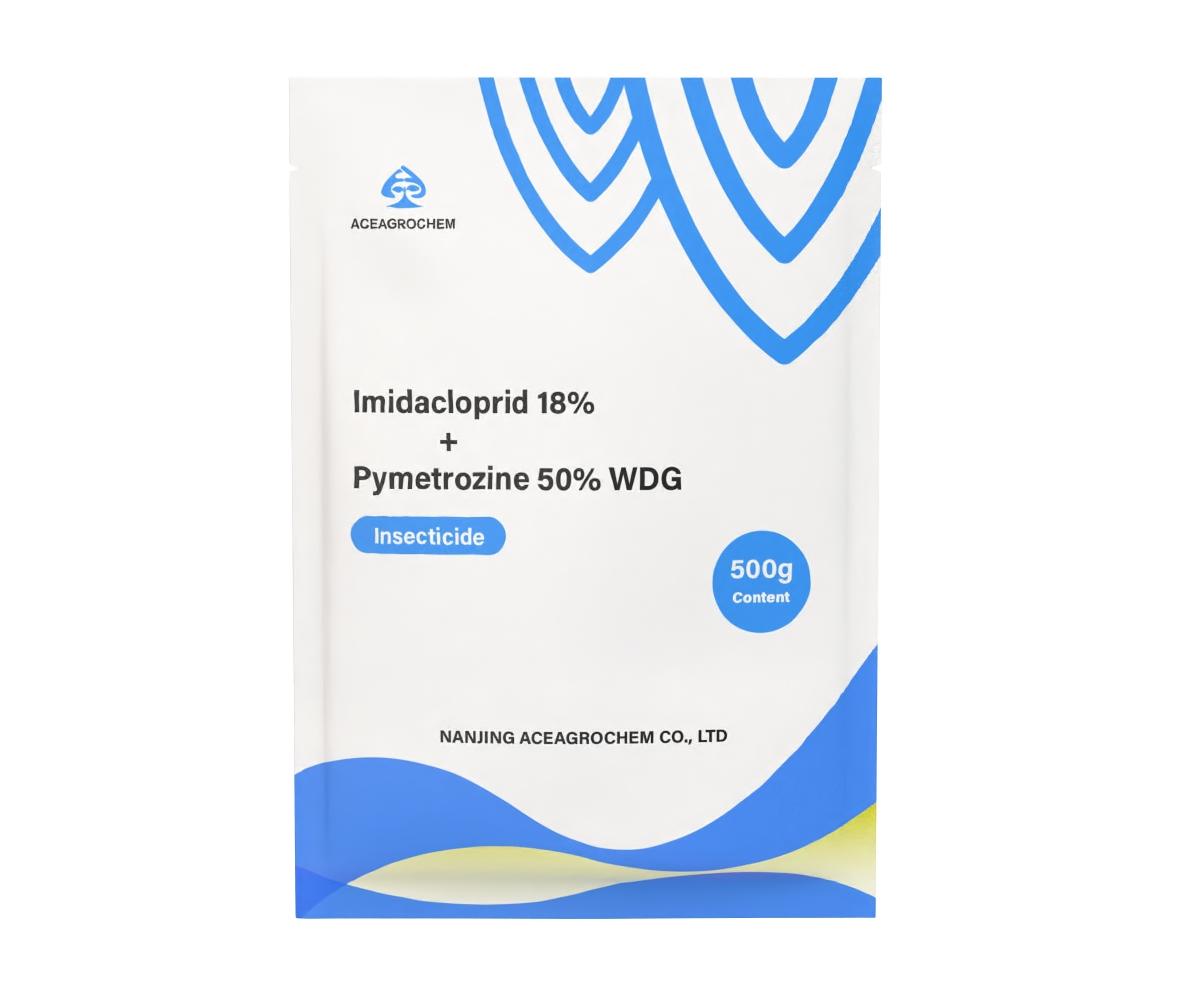
Imidacloprid 18% + Pymetrozine 50% WDG
Classification:
Insecticide
Formulation:
Imidacloprid 18% + Pymetrozine 50% WDG (Water Dispersible Granules)
CAS NO:
Imidacloprid: 138261-41-3;
Pymetrozine: 123312-89-0
USAGE:
This insecticide is effective against a wide range of sucking pests such as
aphids, whiteflies, leafhoppers, and planthoppers in various crops including
rice, wheat, vegetables, and fruit trees.
Pack size:
100g, 250g, 500g, 1kg/bag, or as required
Direction for Use
| Crop | Target Pests | Dosage (Imidacloprid 18% + Pymetrozine 50% WDG) | Application Timing | Remarks |
|---|---|---|---|---|
| Rice | Planthoppers | 100-150 g/ha | At the early stage of pest infestation | 1) REI: 12 hrs 2) Max 2 applications/season |
| Wheat | Aphids | 80-120 g/ha | When aphid population reaches the economic threshold | 1) REI: 12 hrs 2) Max 2 applications/season |
| Vegetables | Whiteflies, Aphids | 70-100 g/ha | At the early stage of pest appearance | 1) REI: 12 hrs 2) Check crop sensitivity |
| Fruit Trees | Leafhoppers, Aphids | 150-200 g/ha | Before the peak period of pest activity | 1) REI: 24 hrs 2) Dilute with sufficient water for spraying |
Product Details
Mode of Action:
-Imidacloprid acts on the nicotinic acetylcholine receptors of insects, causing
nerve blockage and paralysis.
-Pymetrozine interferes with the feeding behavior of pests, leading to starvation
and death.
-The combination has both contact and systemic action, which can quickly control
pests and protect crops.
Benefits:
-High efficiency against multiple sucking pests.
-Good systemic translocation in plants, providing long-term protection.
-Low toxicity to non-target organisms under normal use conditions.
-Compatible with many other Pesticide for tank-mixing.
Precautions:
-PPE: Chemical-resistant gloves, masks, goggles.
-Do not apply in windy conditions (wind speed > 15 km/h).
-Do not mix with alkaline Pesticide.
-Storage: Keep in a dry, cool place at 0°C-35°C.
Environmental Hazards:
-Toxic to bees, avoid application during the flowering period of crops.
-Do not contaminate water sources, as it may be harmful to aquatic organisms.
-Low toxicity to birds and mammals under normal use.